Mardi Gras Throws, Explained: What Gets Thrown, How to Catch It & Which Krewes Have the Best
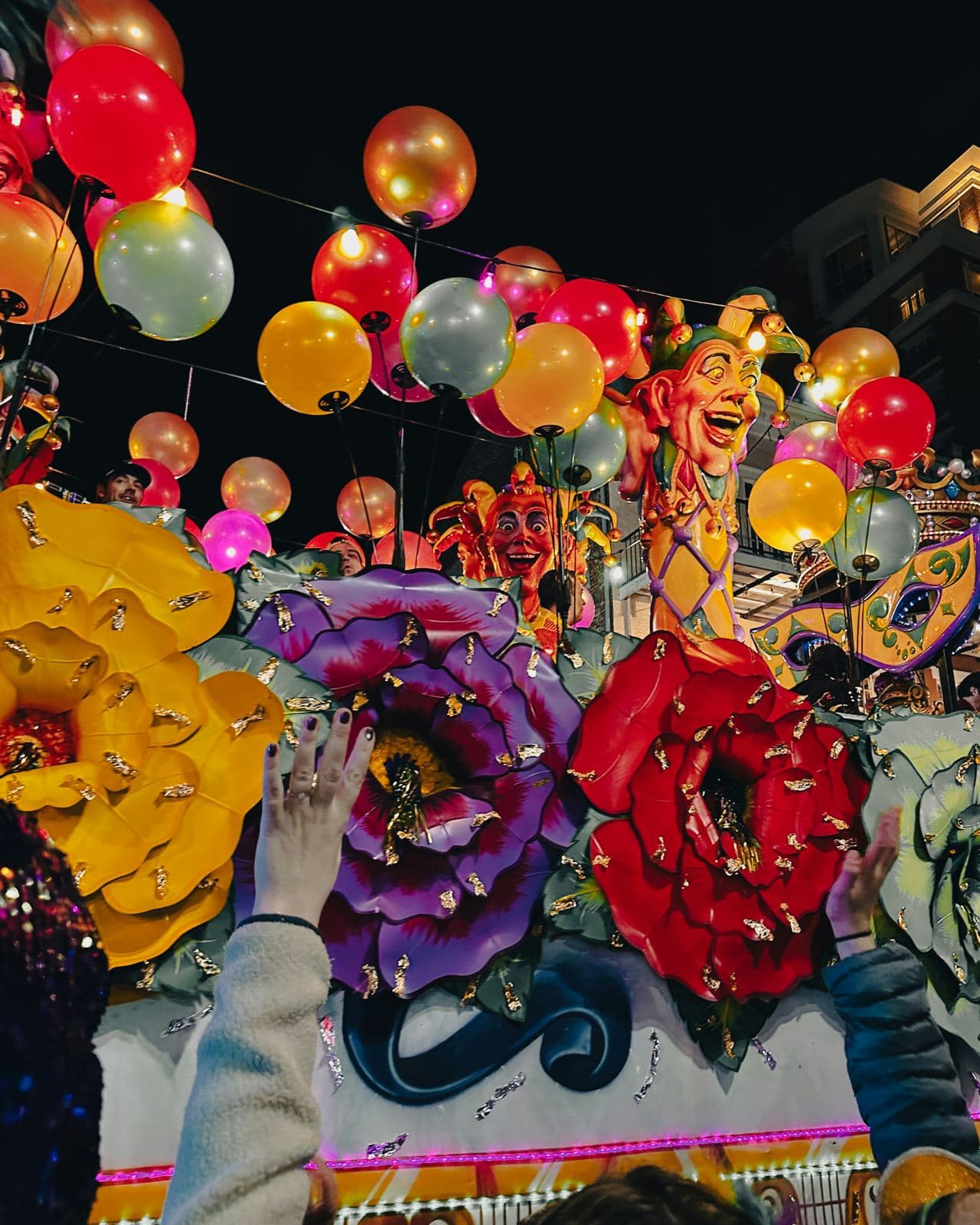
Ask someone who has never been to New Orleans what happens at a Mardi Gras parade and they will say one word: beads.
Beads are real. Beads are also, honestly, the least interesting thing that comes off a float. The plastic strands are the currency of Carnival, but the actual prizes - the ones locals plan entire nights around - are hand-decorated coconuts, glittered high heels, purses, doubloons and a truly absurd number of themed novelties. Riders spend hundreds of dollars of their own money on this stuff. Some of it ends up on a mantel for the rest of your life.
Here is how Mardi Gras throws actually work: what gets thrown, which krewes throw the good stuff, how to catch it without embarrassing yourself, and what to do with the pile at 2 a.m.
What is a "throw," exactly?
A throw is anything a masked rider hands or tosses from a float to the crowd. It is not merchandise and nothing is for sale - throws are gifts, and that is the whole point. Krewe members pay dues, buy their own throws, and then spend four hours giving them away to strangers.
That gift economy explains the two rules that govern everything on the route:
- Riders throw to people who look like they want it. Eye contact, arms up, a shout of "Throw me something, mister!" Do it and you will be flooded. Stand there filming with one hand and you will get nothing.
- What you catch is roughly a function of where you stand. Uptown near the start, riders are fresh and generous. By the end of the route the bags are empty. Middle of the route, at a lull between bands, is the sweet spot.
The throw hierarchy, from common to legendary
Beads
The baseline. Cheap short strands early, longer and heavier strands as the night goes on, and the occasional hand-strung or medallion bead that a rider clearly saved for someone specific. Krewe-logo medallion beads are the ones worth keeping - generic purple, green and gold strands are the ones you will leave in a hotel drawer.
Doubloons
Aluminum coins stamped with the krewe's emblem on one side and the year's parade theme on the other. Rex introduced them in 1960 and they became an instant collectible - people still trade them, catalog them by year, and frame full sets. Doubloons land on the ground and skitter, which brings us to the single most important safety rule of Carnival, below.
Cups
Plastic go-cups printed with the krewe name and year. Locals genuinely use these for the next decade. Do not laugh - open a New Orleans kitchen cabinet and count the parade cups.
Novelty throws
Light-up swords, stuffed animals, frisbees, koozies, beanies, plush alligators, foam footballs. Endymion and Bacchus, the big super krewes, throw these by the crate.
Signature throws
This is the real game. A handful of krewes have one specific, hand-decorated object that people chase for years:
- Zulu coconuts - hand-painted and glittered, the most famous throw in Carnival. By city ordinance and krewe practice they are handed down, never thrown, so you have to be at the barricade and you have to make friends with a rider.
- Muses shoes - a glittered, individually decorated high heel. Muses rolls the Thursday before Fat Tuesday and the shoe hunt is a serious competitive sport.
- Nyx purses - decorated handbags, same idea, thrown by an all-women krewe on the Wednesday of the final week.
- Tucks toilet brushes - yes, really. Tucks leans into the joke and the brushes are beloved.
- Iris sunglasses and decorated bags, Alla genies, Hermes glass beads, Chewbacchus hand-made sci-fi trinkets - nearly every krewe now has a hand-decorated hero throw.
If your goal is to bring home one thing you will actually keep, plan your night around a signature-throw krewe rather than around the biggest floats.
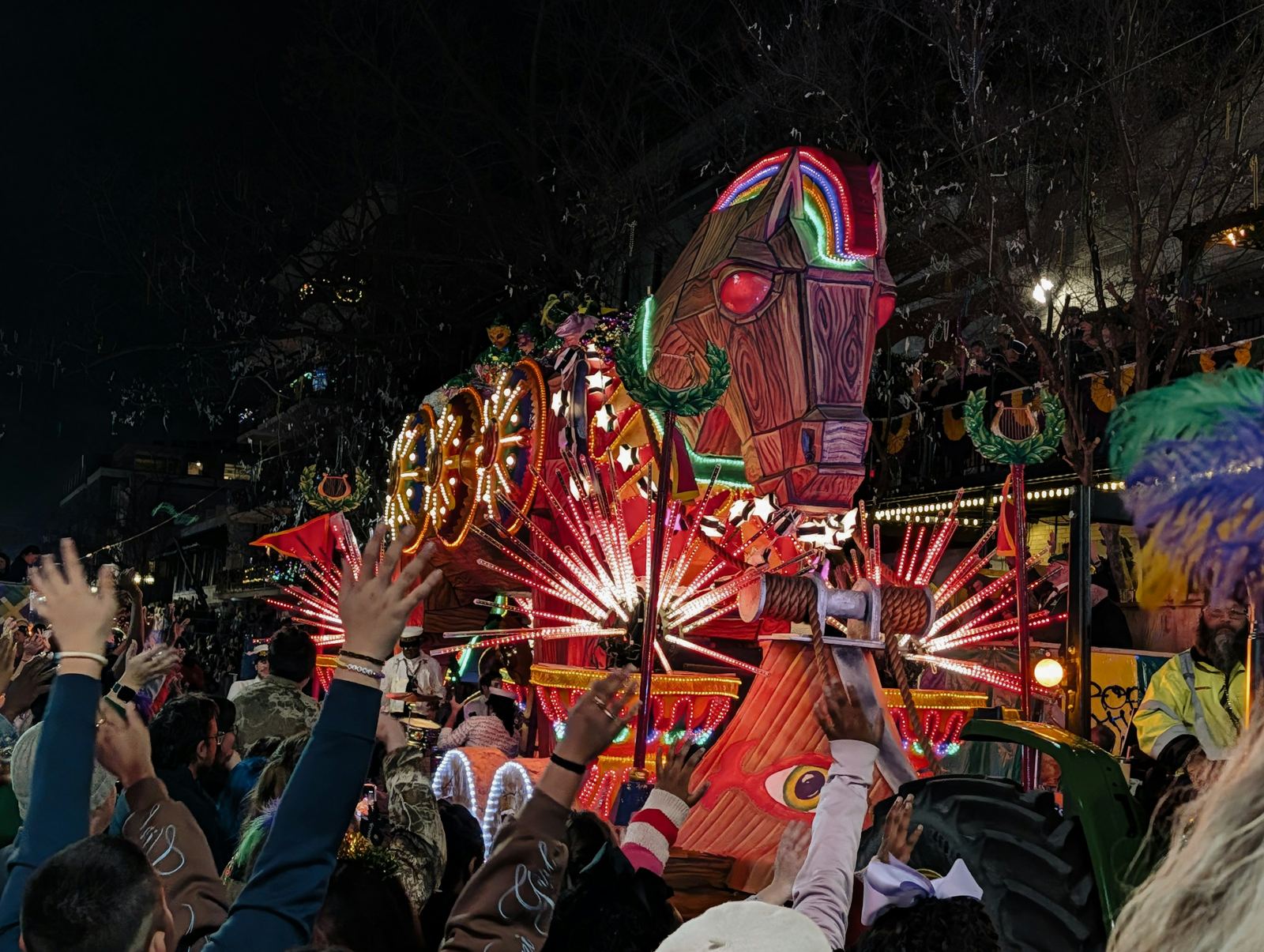
How to actually catch throws
Stand in the right place. The neutral ground (the median) is calmer, wider and better for families. The sidewalk side is tighter and more competitive but you are closer to the riders. Corners where floats slow to turn are gold. So is any spot right after a marching band, when the crowd's attention has drifted.
Get your arms up early. Riders pick targets a float-length ahead. If your hands go up only when the float is level with you, you are already too late.
Make eye contact and ask. "Throw me something, mister!" is not a tourist cliche, it is the actual functioning protocol. Costumes help. Kids on ladders clean up. So do people who look like they are having the most fun on the block.
Catch with two hands, palms open. Long heavy strands hurt. Never try to snatch a bead out of the air one-handed above someone else's head.
Never put your hand flat down on a doubloon. Locals stomp a foot over a doubloon on the ground and then bend to pick it up - that is the correct move, because a hand flat on the pavement in a crowd is how fingers get stepped on. Learn the stomp.
Bring a bag. A tote or a small backpack. You will be carrying more than you think within twenty minutes, and beads around the neck get heavy and hot fast.
Throw etiquette locals actually enforce
- Don't grab from kids. Ever. Riders are aiming at the child and everyone on the block will notice.
- Don't dive into the street. The space between the crowd and the float belongs to marching bands, flambeaux carriers and tractors. It is also the most dangerous place at a parade.
- Don't fight over a bead. It is a fifteen-cent piece of plastic and there are eleven more floats coming.
- Do share. If you catch a duplicate signature throw, hand it to the person next to you who missed. This is the fastest way to be treated like you belong.
- Don't stand on a ladder unless it is set back from the curb the required distance and you brought children. Ladder rules are taken seriously.
What to do with your throws afterward
The morning after, everyone faces the same pile. Options, in order of how locals actually handle it:
- Keep the good stuff. Signature throws, medallion beads, doubloons, cups. That is maybe ten percent of the pile.
- Recycle the rest. New Orleans has bead recycling programs - most famously through Arc of Greater New Orleans, which employs people with disabilities to sort and resell donated beads back to krewes. Drop-off bins appear around the city during and after Carnival.
- Do not fly home with forty pounds of plastic. You will not use it. Someone here will.
Leaving beads in a tree is a New Orleans tradition and also, at scale, a genuine drainage problem - the city has pulled tons of beads out of storm drains along the parade route. Catch enthusiastically, keep selectively.
Planning your parade around the throws
Different krewes, different loot. If signature throws matter to you, the Wednesday-to-Sunday stretch before Fat Tuesday is where the hand-decorated krewes cluster, while the super krewes on that final weekend throw the biggest volume of everything else.
Browse the krewe guide to see who throws what, then use the parade planner to build a night around the ones you care about. If you are still deciding where to stand at all, start with our breakdown of Mardi Gras parade routes and the best viewing spots, and check parade times so you are on the route before the first float rather than after it.
Arms up. Two hands. Stomp the doubloon.
Photos by Katie Montgomery on Unsplash.
More from the Dispatch
The Mardi Gras Price Index: What a Hurricane, a Po-Boy and a Beignet Cost Over Time
We tracked what New Orleans staples cost on archived menus and set them against national inflation. The Hurricane and the po-boy fell behind, the beignet pulled ahead, and the Sazerac matched restaurant prices almost exactly.
Endymion 2027: Parade Date, Start Time, Route and the Extravaganza
Endymion rolls on Saturday 6 February 2027 at 4pm, confirmed by the krewe. Here is the Mid-City route, when the floats reach each stretch, where to watch, the city rules for claiming a spot, and what to know about the Extravaganza in the Superdome.
When Mardi Gras 2027 Parades Actually Start: The January Schedule
Carnival opens on 6 January 2027, but the big parades do not. Here is what rolls in January, what the quiet fortnight in between is really like, and why booking around Twelfth Night is usually a mistake.