Getting Around New Orleans During Mardi Gras: Parking, Streetcars, Road Closures & Rideshare
Every year, someone flies into New Orleans for Mardi Gras, rents a car at the airport, and spends the next four days learning an expensive lesson. The car sits. Then it gets towed. Then it costs more to retrieve than the flight did.
Here is the thing nobody puts on the parade schedule: during Carnival, New Orleans stops working like a normal city. The streetcar you were counting on is a bus. The street your hotel is on is closed to traffic. Your rideshare cannot physically reach you because there are eleven marching bands between you and the driver.
None of this is a problem if you know it is coming. This is how locals actually move around during Mardi Gras.
The one rule that explains everything
The parade route is a wall.
For the hours around a parade, the route is not a street you can cross by car. It is a barrier that splits the city in two. Uptown and Downtown effectively become separate islands connected only by people on foot.
Once you internalize that, every other decision gets easy. Do not plan to drive across a parade route. Do not book a dinner reservation that requires crossing one. Do not assume a five-minute drive is still five minutes.
If you are not sure where the wall is on a given night, our parade routes guide maps the St. Charles Avenue route block by block, and the parade planner will show you what rolls when.
Parking during Mardi Gras: the rules that actually get enforced
New Orleans parking enforcement is relaxed for most of the year. During Carnival it is not.
Temporary no-parking restrictions go into effect along the parade route ahead of each parade so floats can stage safely and residents are not boxed in. Historically that window was two hours before the parade; the city has since pushed it earlier and longer. Any unauthorized vehicle left inside that zone gets ticketed and towed, and NOPD has authority to tow anything obstructing the route, including golf carts and ATVs.[1]
The permanent rules that catch visitors year-round get enforced hard during Carnival:
- Never park on the neutral ground. The grassy median is not a parking space, no matter how many people are standing on it.
- Stay 20 feet back from any crosswalk, intersection, or stop sign.
- Stay 15 feet from a fire hydrant. Carnival crowds hide hydrants. Walk around and look before you leave the car.
- Do not block a driveway, even partially, even for an hour. Uptown residents call it in.
- Do not park on the sidewalk. This is legal in some cities. Not this one.
If your car is gone, call the city at 504-658-8100 before you assume it was stolen.[2] It was probably towed.
The honest answer on where to park
Do not. If you are staying Uptown or in the Garden District, leave the car parked for the whole trip and walk to parades. If you are Downtown, use a garage in the CBD or Warehouse District and treat it as storage, not transportation. Garages cost less than one tow plus one ticket, and you will sleep better.
If you are driving in for a single day, park well outside the parade route, on a side street in a neighborhood that has no parade that night, and walk in. Give yourself twenty minutes of walking. That is the trade.
Streetcars and buses: expect substitutions
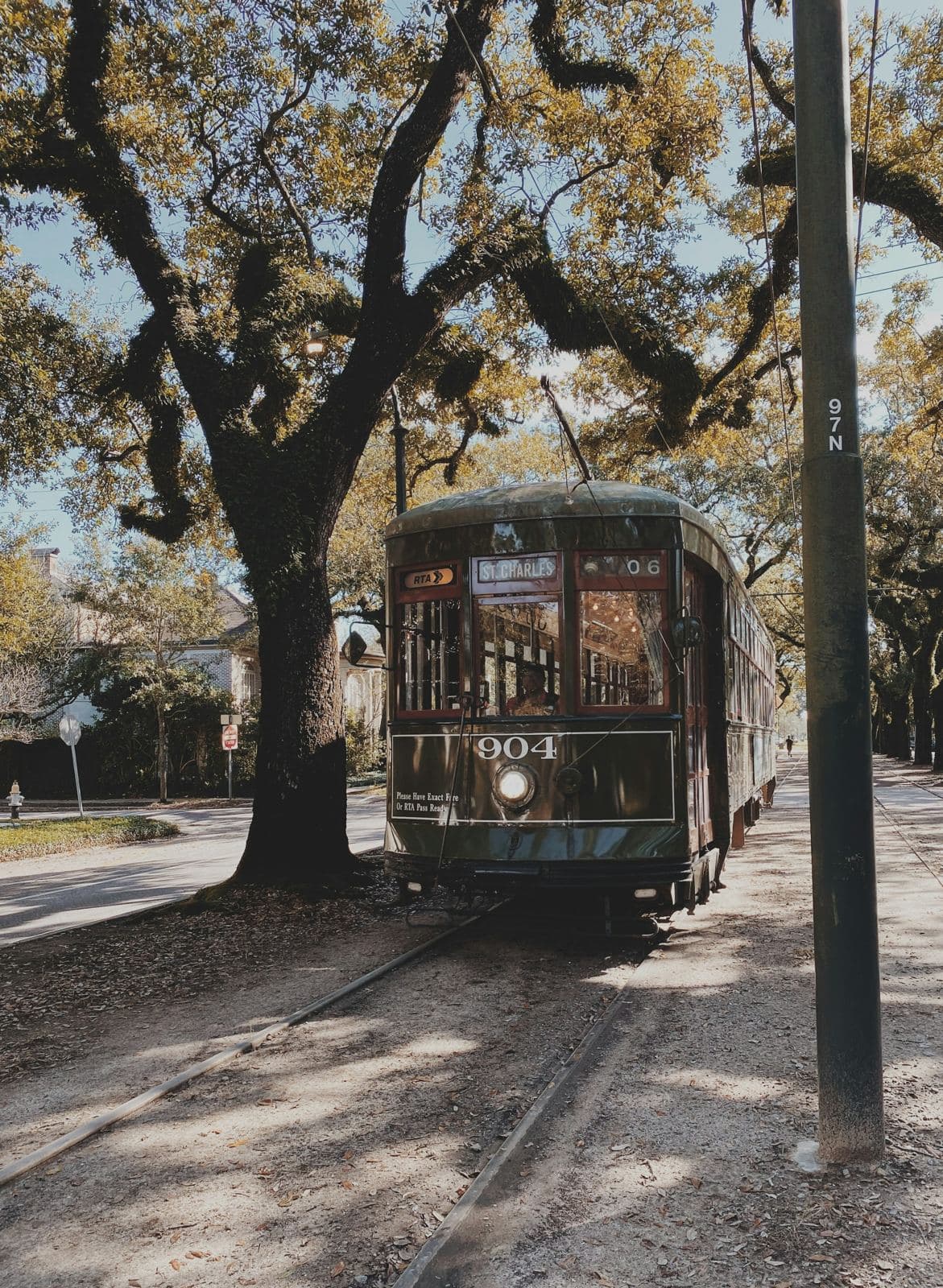
This is the change that surprises people most. The St. Charles streetcar does not run through the heart of parade season. It cannot: the parades roll on the tracks.
In a typical year, RTA suspends streetcar service on the St. Charles line, and often the Canal and Rampart lines too, starting in the days before the final Carnival weekend, and replaces it with continuous bus service along those corridors through Mardi Gras Day.[3] Normal service resumes the day after Fat Tuesday.
Bus routes also get detoured, typically starting a couple of hours before each parade and staying detoured until the route is cleared and swept.[4]
What this means for you:
- Do not build a plan around riding the St. Charles streetcar to a parade. It is a lovely ride in January and a nonexistent one in February.
- Check the RTA's Mardi Gras rider's guide for the specific year you are visiting. They publish one every season with exact suspension dates and shuttle routes.
- Buses will be slow and full. Budget double the time you think.
- The Canal Street ferry to Algiers Point keeps running and often adds service. If you are staying on the West Bank, it is the single most reliable way in and out.
Rideshare: possible, but manage your expectations
Uber and Lyft both operate during Carnival, and both become substantially less useful the closer you get to a parade.
Three things go wrong:
- Surge pricing. A fifteen-dollar ride after Endymion lets out can be sixty. This is not a glitch.
- The driver cannot reach your pin. If you are standing on a closed street, your driver is circling a barricade several blocks away while your wait time climbs.
- You cannot find each other. Fifty thousand people in costume, one silver Camry, no cell signal.
The fix locals use: walk out first, then request. Get yourself six to ten blocks off the route, to a normal intersection with a name you can say out loud, and order from there. It takes ten minutes of walking and saves forty minutes of standing.
Also worth knowing: cell networks genuinely struggle in dense parade crowds. Screenshot your addresses and agree on a physical meetup landmark with your group before you split up.
Walking is the real answer
Here is what locals know: during Carnival, walking is not the fallback. It is the fastest mode.
A car covering a mile Uptown on a parade night can take forty-five minutes. You can walk that mile in twenty. Nobody tows you, nothing surges, and you see more of the city.
Practical walking notes:
- Wear real shoes. You will do five to eight miles on a heavy parade day without noticing.
- Cross the route between parades, not during. Police close crossings once floats are moving.
- The neutral ground is your sidewalk on St. Charles. Use it to move along the route rather than pushing through the curb crowd.
- Have a bathroom plan. This is the actual constraint on how far you can wander, not your legs.
- Bikes work well in the Marigny, Bywater and the Quarter. Lock them somewhere sane and remember you cannot ride across a parade.
The airport question
Louis Armstrong International is about 30 to 40 minutes from downtown on a normal day. During Carnival weekend, budget an hour and a half, and more if a parade is rolling near your route.
If your flight home is on Ash Wednesday morning, leave earlier than feels reasonable. The whole city is doing the same thing on the same tired legs.
A simple plan that works
- Do not rent a car unless you are staying outside the city and driving in on non-parade days.
- Book lodging within walking distance of the parades you care about. This is the single highest-leverage decision of the whole trip - see our neighborhood guide.
- Pick one side of the route per day and stay on it.
- Check RTA's Carnival guide the week before you fly, for that year's exact streetcar suspensions.
- Walk first, ride second.
Mardi Gras 2027 falls on Tuesday, February 9, which means the heavy parade stretch runs through the weekend before. Plan your movement now and you will spend Carnival watching parades instead of watching a tow truck.
Cover photo and in-body photo by Chelsea Audibert and mana5280 on Unsplash.
Sources
More from the Dispatch
The Mardi Gras Price Index: What a Hurricane, a Po-Boy and a Beignet Cost Over Time
We tracked what New Orleans staples cost on archived menus and set them against national inflation. The Hurricane and the po-boy fell behind, the beignet pulled ahead, and the Sazerac matched restaurant prices almost exactly.

Endymion 2027: Parade Date, Start Time, Route and the Extravaganza
Endymion rolls on Saturday 6 February 2027 at 4pm, confirmed by the krewe. Here is the Mid-City route, when the floats reach each stretch, where to watch, the city rules for claiming a spot, and what to know about the Extravaganza in the Superdome.
When Mardi Gras 2027 Parades Actually Start: The January Schedule
Carnival opens on 6 January 2027, but the big parades do not. Here is what rolls in January, what the quiet fortnight in between is really like, and why booking around Twelfth Night is usually a mistake.